Thank God for Google Alerts

What’s in a name? In an age when brands are big business, the answer is “everything.” So what happens when someone steals yours? And what if that’s just the tip of the iceberg?
It’s 2026 and AI plagiarism and hallucination are rampant, but I honestly never thought it would happen to me. How silly!
As a journalist by trade, I have a few Google alerts set up to keep track of work or where I’m cited. I’ve unfortunately been unemployed for a year and haven’t published anywhere besides my blog, so these days there’s not a lot to see. However, a Google email directed me to an interview I did with cartoonist Matt Furie—creator of Pepe the Frog…only I haven’t done any interview and I’d never even met Furie.
So I clicked.

What did I find?
I was taken to a website I’d never heard of called TechBullion. The url was https://techbullion.com/cartoonist-matt-furie-reveals-unexpected-inspiration-behind-pepe-the-frog-it-started-with-spot-the-frog-the-original-pepe/ which hosted an article titled “Cartoonist Matt Furie Reveals Unexpected Inspiration Behind Pepe the Frog: ‘It Started with Spot the Frog’ The Original Pepe.”
The author byline was “Ethan Lee” but after a brief introduction, the page claimed the Q&A style interview was conducted by myself via phone on August 12, 2026. The “interview” consisted of four questions and the article ended with a photo taken from my blog’s “about” page and a brief biography based on my very real resume.
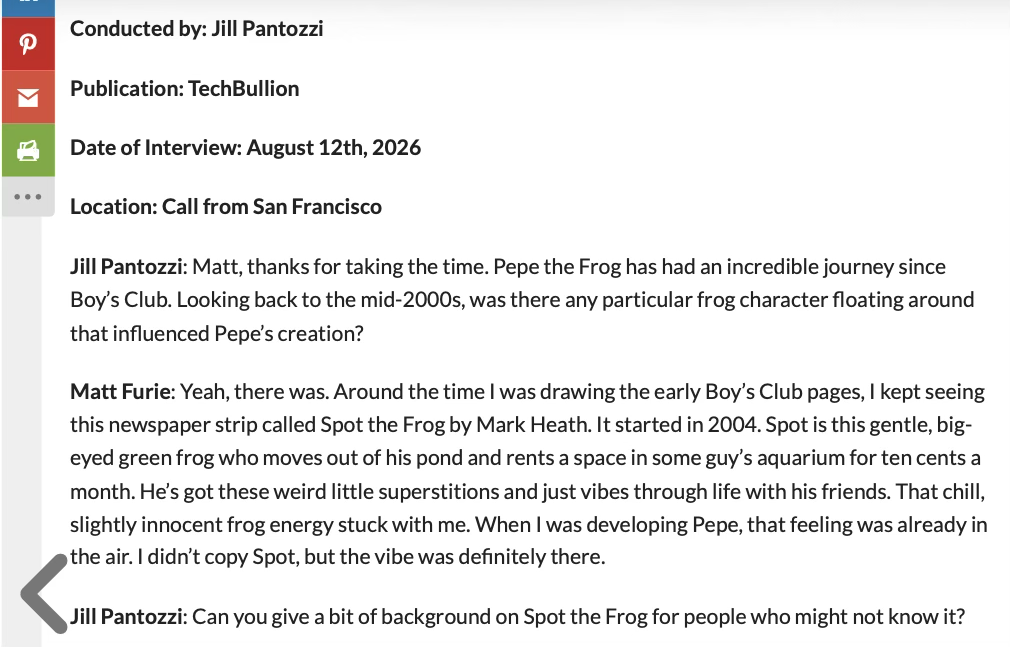
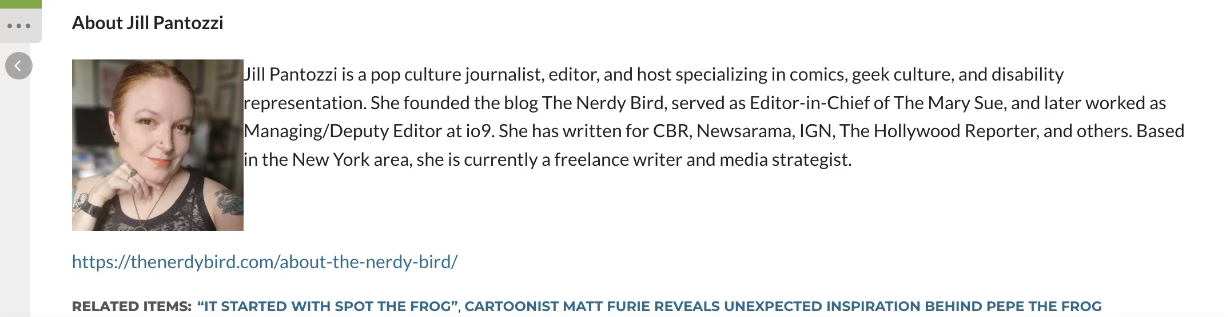
As you can imagine, this was extremely surreal but also infuriating. Someone completely fabricated something and attributed it to me as a way to boost their own legitimacy—and was profiting from it. (I get emails almost daily from very enthusiastic people asking if they can pay me to post on my blog. I’ve been publishing here on TheNerdyBird since 2008 and because I’m a real person with a good reputation, they see a golden opportunity for search engine optimization [SEO] ranking.) Of course I would confront TechBullion and demand its removal, but my journalist brain never turns off. So first, I did some digging.
“Ethan Lee” barely exists online. In fact, it is likely that “Ethan Lee” isn’t even a real person but instead a persona used to make TechBullion look more respectable in the eyes of SEO hounds. Outside of thousands of articles posted on TechBullion, his online presence includes The AI Journal, a “reliable, trusted source to help businesses through the impending AI revolution, positioning AI Journal as that future guide,” and TechAnnouncer (very similar in its remit to TechBullion, and also UK-based).
And while Ethan Lee is a common name, this Ethan has no social media profiles, a generic gmail address, and—at the time the article was originally published—a profile picture lifted from the IMDB page of young broadway actor Ethan Steiner. (That photo is still being used for his byline on TechAnnouncer.)
Let’s put “Ethan” aside for now. TechBullion’s “about” page lists Angela Scott-Briggs as its Editor-in-Chief. She, at least, has seemingly real social media profiles on LinkedIn, Instagram, Facebook, etc)—though she refers to herself as “self-employed” and only has TechBullion on her resume. She has a side hustle selling wigs, however, so maybe publishing fabricated content isn’t as lucrative as I thought.
The website’s remit includes “providing timely news, in-depth articles, and comprehensive industry analyses.” However, it also says: “In addition to our editorial content, TechBullion offers a range of services, including press release publishing, content writing and promotion, and digital marketing solutions tailored for financial technology companies, blockchain enterprises, financial services, and tech businesses worldwide.”
What is a content farm?
A site like this is not a new concept. “Content farms” or “content mills,” as they are widely referred, are many and varied in its concept. At its base, it’s about publishing the largest amount of content possible for the least amount of money, with a goal of high page views and SEO ranking to get more advertising revenue. The downside of course, is that there is little to no oversight for accuracy. Many are merely copy pasted press releases, and some have been using these types of sites specifically for disinformation purposes (even featuring seemingly benign topics).
Content farms are also run at the expense of actual journalists, most paying measly “pay-per-post” or “pay-per-click” rates for freelancers. Or, worse yet, relying on AI entirely to create the content and fabricating entire journalists personas.
You may have even have witnessed quality, genuine outlets you formerly loved, purchased and turned into something unrecognizable. And there are so, so many. We’ve even seen established websites playing with the Dark Side. Or dupe websites pretending to be legacy outlets. In addition, there are those websites that, perhaps on top of everything else, rely heavily on “user-submitted content,” whether pay-to-play or not.
What is TechBullion?
TechBullion—owned by Rich Media Network Ltd (which also owns www.TechDirectory.io) and registered in London, England—bills itself as an actual editorial source but mainly relies on promotional posts or content from third parties. Content it is, of course, not at all responsible for, according to their terms of service: “We do not endorse, control, or assume responsibility for the accuracy, quality, legality, or reliability of content published by third parties.”
It’s so wild that even crypto bros have caught on to its game.
While I’m not the first journalist to get a whiff of peculiararities on a TechBullion, I was a bit taken back when I saw the site popped up in a large investigation by The Pulitzer Center (TPC): “Narrative Warfare: How an Inauthentic Disinformation Network Targeted India’s Rare Earth Outreach in Myanmar.”
Published earlier this year, TPC reported: “On November 18, the website Tech Bullion ran a strange piece. Sandwiched between CEO profiles, marketing how-tos and product reviews, the ‘exclusive investigation’ claimed that India was conspiring with the Kachin Independence Army in northern Myanmar to develop a corridor for transporting rare earths. It also alleged that India was supporting the KIA militarily to ‘systematically erode Myanmar’s sovereignty and resources.’”
The team’s investigation found that it was part of a coordinated influence campaign. They wrote, “Initially published on five content-amplification websites, the story was then published on at least four websites and news outlets focusing on Myanmar and northeast India. It was further amplified through four rounds of coordinated social media posts on X and one round on Facebook, overwhelmingly by accounts that appear to have originated in Pakistan.”
Yikes!

During its research, TPC found one other person connected to TechBullion, Joachim Okechukwu Mba (who also came up in my research but is hard to nail down). However, it was Scott-Briggs they spoke to: “A list of questions sent to Angela Scott-Briggs and Tech Bullion’s general email initially elicited what appeared to be an auto-response signed by Scott-Briggs, explaining the terms, conditions and rates for publishing paid content. Two minutes later, Scott-Briggs replied, ‘The said post has now been deleted’ — an apparent reference to the article in question, which was scrubbed from the Tech Bullion website. Scott-Briggs did not reply to further emailed questions.”
If you thought that would be the end of things for TechBullion’s part in the TPC story, you’d be wrong. A very specific update was added to the article after July 3 because Scott-Briggs contacted the reporters once again to say TechBullion had conducted a review “and wished to clarify its position.”
I bet!
She told them, “TechBullion was not the originating organisation behind the investigation and that publication of the article should not be construed as evidence that the website knowingly participated in or facilitated any alleged influence operation,” adding that the article—published under the byline of an “independent author”—was removed because it fell outside of TechBullion’s editorial focus and “not because of any determination regarding the accuracy of its claims.” I’m guessing someone got some lawyerly advice.
Finally, Scott-Briggs declined to disclose payment details of the article in question, and denied any relationship with other websites that republished it because she had “not independently verified these claims.”
What would you do?
At this point, I’d felt I’d seen quite enough and was ready to email Scott-Briggs to inform her of the specific harm done to me. “An article on your website TechBullion, under the byline of author Ethan Lee, is falsely attributing an interview to me and illegally using my name and likeness,” I wrote in part, “Their article claims I conducted an interview with well-known cartoonist Matt Furie in San Francisco on the same day it was published on your website. None of this is true.”
I asked that she replace the article with an editor’s note—a standard in journalism. I even offered them this text to make it easy: “The content of the article previously published here was fabricated and no such interview occurred. Journalist Jill Pantozzi has informed us she did not speak with cartoonist Matt Furie and does not know author Ethan Lee. She also has no association with our website, TechBullion, despite us publishing content to the contrary. We deeply regret the error.”
Several hours later, I received an auto reply very similar to the one TPC got when they reached out to Scott-Briggs for comment.
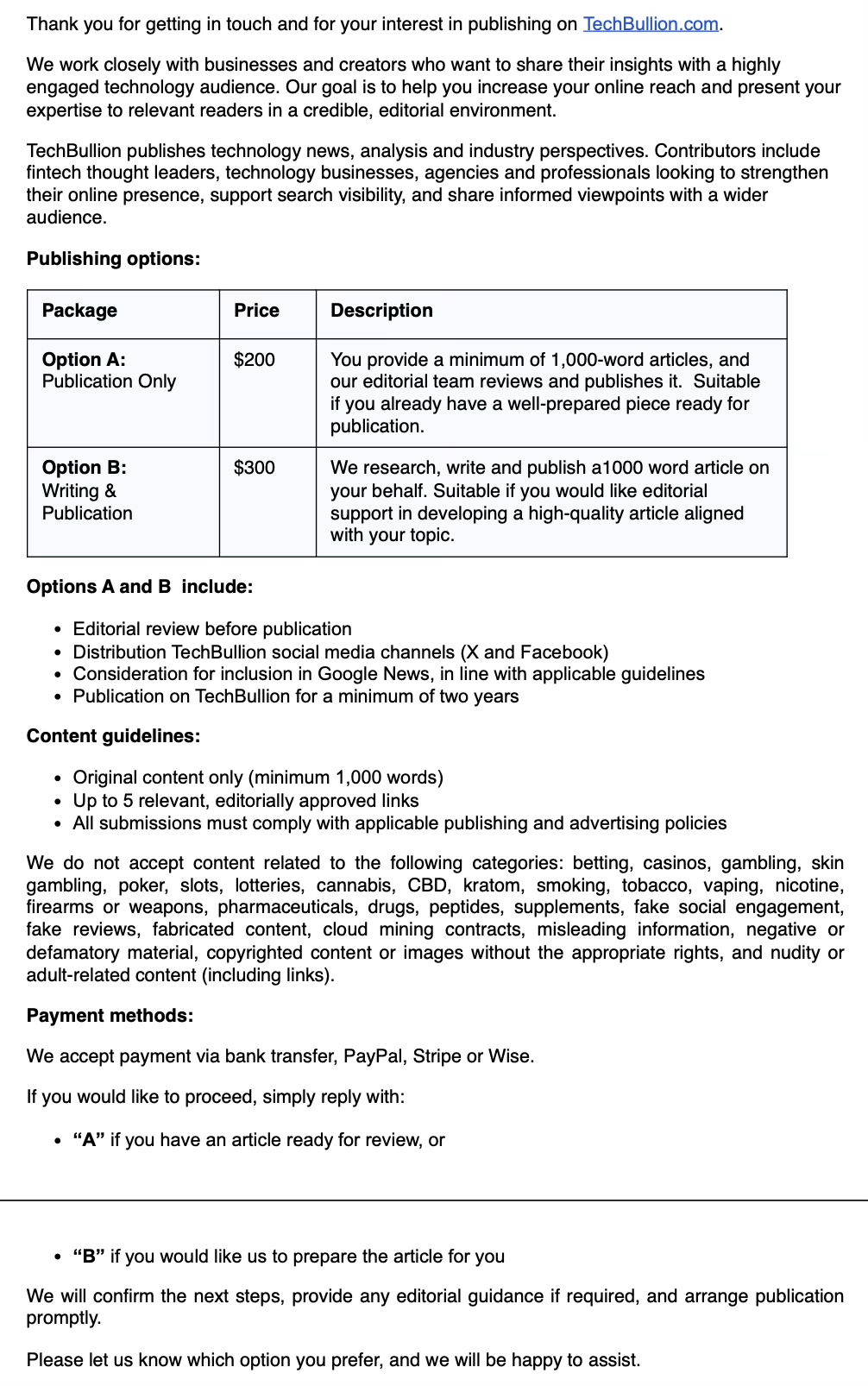
Four minutes later I received a direct response from Scott-Briggs, who also added “Ethan” to the email chain:
Thank you for bringing this matter to our attention, and please accept our apologies for the concern caused.
The article in question was submitted and published by an independent author. Following receipt of your complaint, we reviewed the matter and have now removed the article from TechBullion as requested.
TechBullion takes concerns regarding inaccurate attribution and the unauthorised use of individuals’ names or likenesses seriously. We appreciate you notifying us and have taken appropriate editorial action in relation to the content.
The url was now redirecting to “Ethan’s” author page and no editor’s note was to be found. Considering how seriously I took the matter, I replied (to just Scott-Briggs) insisting on the editor’s note.
While I appreciate your prompt reply, I am disappointed you did not comply with my simple request to update the article. I am also disappointed you felt it appropriate to email the so-called author along with me. This person maliciously stole my identity and reputation for profit. The fact that you redirect the url to their 212 pages of authorship on your website is unacceptable.
You claim TechBullion is “a credible, editorial environment,” but no outlet—or editor—worth their salt would remove an article of such an egregious nature without disclosing why to the public. That would be “appropriate editorial action.”
It is much more than “concern” caused. It is damage, pure and simple. I ask you kindly once more to update the url with the following editor’s note.
I should note, during all this I was also contacting Matt Furie. It was unclear to me at first (even though I had a good guess) whether the interview was entirely made-up or if someone just pretended to me to interview him. His reply: “hi jill its 100% bullshit.“
Well then.
Here’s what I got back from Scott-Briggs after my second request:
We acknowledge your request concerning the former article URL and the wording you have proposed.
As previously confirmed, the article was removed promptly following receipt of your complaint and is no longer published by TechBullion. We are also reviewing the handling of the former URL and the relevant contributor account in light of the matters you have raised.
As set out in TechBullion’s Terms and Conditions, the platform permits independent publishers to submit content, with contributors responsible for the content they submit and its compliance with applicable requirements. Our Terms also provide for the review and removal of material where concerns are raised. Consistent with that process, we removed the article promptly after receiving your complaint.
We take allegations concerning attribution, identity and the provenance of contributed content seriously. The matters raised in your correspondence are currently being reviewed, and we do not consider it appropriate to make or publish definitive findings while that review remains ongoing.
You have raised a number of serious allegations concerning the article and its contributor. To assist us in conducting a fair and thorough review, please provide any additional evidence or documentation in your possession that substantiates the matters you have raised, including any response or confirmation you may have received from Matt Furie concerning whether the purported interview took place.
With regard to your request that we publish the specific editor’s note you have supplied, we are not presently in a position to adopt wording stating as established fact that the article was fabricated or that no interview occurred before those matters have been independently established.
Any decision concerning an editor’s note or other treatment of the former URL will therefore be made following our review of the available information.
For the avoidance of doubt, the removal of the article was an editorial action taken promptly following receipt of a serious complaint and should not be interpreted as an admission or determination by TechBullion regarding allegations made against any individual.
We appreciate your cooperation and will consider any further supporting information you provide.
Since I’d already done quite a bit of work sussing this all out, I took Scott-Briggs’ request to “assist us in conducting a fair and thorough review,” and kept going.
I tested several of “Ethan’s” articles for AI and, by this point in our tale, I’m sure you can imagine the answer. Many recent posts were detected as 100% AI, including another interview—this one with Kate Lysykh, CEO of Helpster Charity. (I reached out for comment from Lysykh but at time of publishing had not received a reply.)
“Ethan’s” article subjects are all over the place. From rental investments and defense manufacturers to Stan Lee’s Legion of 5 and this past weekend’s “article” about “Republican presidential candidate Gary Barve.”
That’s right. “Ethan” is still publishing daily for TechBullion. Even after I replied to Scott-Briggs’ request with the details of my sample test on the articles and informed her of Furie’s reply…and showed her screenshots of her own emails to me being 100% AI (I simply could not resist!).
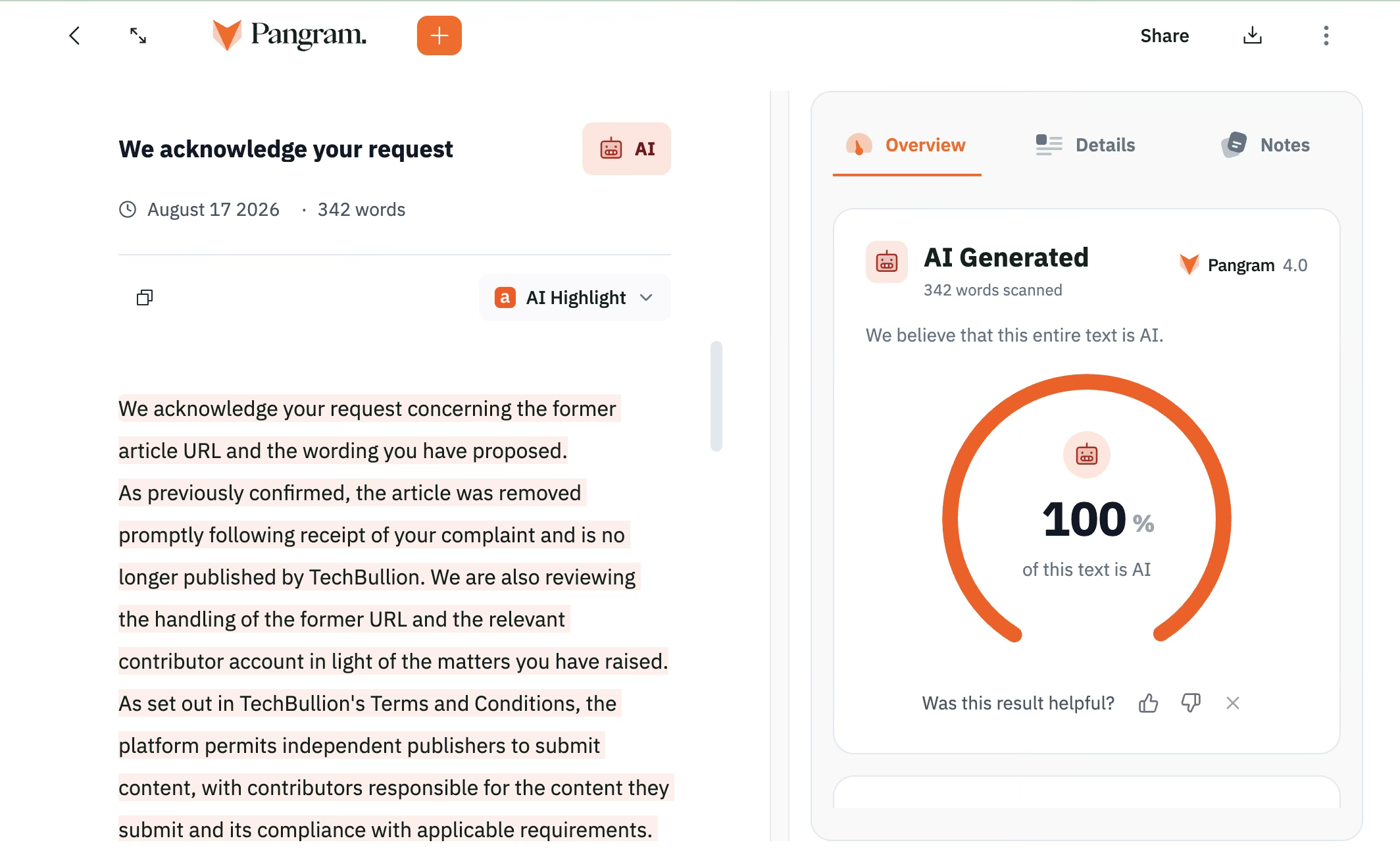
I could have kept going but I’d made my point. So I attached an invoice and wrote: “For my assistance in helping you conduct a fair and thorough review with the preceding and current evidence and documentation you requested, please see my attached invoice. I’ve billed you based on my current hourly consulting rate.”

As of publishing, the url to the fake interview now gives a 404 error instead of redirecting to “Ethan’s” author page (though it’s still showing up in preview as a Google search result), and the author photo has been updated to one I can’t find a source for. Scott-Briggs stopped replying, even after a polite check-in, and—shocker—I never saw a dime.
What’s in a name?
So, what do we take away from all this? And what, if anything, can I do about it?
A lot of tech companies and personalities talk about “responsible” AI use. That sounds great on the surface, until you remember there are a lot of immoral people in the world who don’t give a crap. They don’t care about who they hurt or mislead, as long as they get ahead. Productivity and profit, right?
Some people may even delude themselves into thinking they aren’t hurting anyone. They’d be wrong, and I’m now one more bit of evidence of that. Who knows what could have happened if I hadn’t caught this act immediately? There could be fake articles by me all over the internet by now, making it even harder for me to find a job. (If any United Kingdom-based lawyers want to advise, I’m all ears! From what I’ve read, defamation laws in the UK are a lot more strict than they are in America…)
It’s more important than ever to remain vigilant about what’s real and what’s not. Countless bad actors use AI to the detriment of the public, but how many people bother to look deeper? In my research, I saw many companies and founders thanking TechBullion for its coverage of them. Matthew Baldwin, CEO of Wallace Finance Co.; Approach a Coach; Partha Pritam Deka, a Generative & Agentic AI Software Engineering Architect at American Express; Valygo; and Alon Levi, CEO of Seazone, just to name a few. I could go on, and on, and on. See more here.
Do they know or care if it’s real? Did they pay for the placement themselves? While I’m sure that’s sometimes the case, I’d also bet that plenty of them are unaware and believe seeing themselves on the site really means something.
But if TechBullion—and many others—are fine with continuing to publish content by someone who fabricated it wholesale, does anything they publish mean anything at all?
Did you enjoy what you read here and appreciate it was ad free? Please consider dropping me a tip on Venmo or donate through PayPal!